
What was the project and why was it projected as a game-changer for Kerala’s transport sector? Why did the land acquisition process trigger protests? What processes were put in place to acquire land? What were the concerns over the project?
The story so far:
On May 20, the United Democratic Front (UDF) government in Kerala decided to denotify the SilverLine semi-high speed rail corridor, championed by the previous Left Democratic Front administration. Chief Minister V.D. Satheesan said that the government was not against high speed rail development as such, but that the SilverLine project was both “an environmental disaster” and “financially unviable”. He also announced that all the police cases registered against those opposing the project would be withdrawn.
What was the SilverLine project and why was it projected as a game-changer for Kerala’s transport sector?
The SilverLine project, estimated at ₹64,000 crore, was designed as a semi-high speed rail corridor connecting Thiruvananthapuram to Kasaragod over 530 km. Its objective was to cut travel time from nearly 12 hours to about four. The project was to be implemented by the Kerala Rail Development Corporation (K-Rail), a joint venture between the State government and Indian Railways in a 51:49 equity partnership. K-Rail was created in January 2017 to fast-track railway infrastructure development in the State. In 2021, the Kerala Cabinet granted in-principle approval for the SilverLine project and sanctioned some ₹2,100 crore to be raised through the Kerala Infrastructure Investment Fund Board (KIIFB) for land acquisition.
The proposed line was a standard-gauge corridor, planned largely parallel to the existing railway network and mostly elevated on embankments. It envisaged trains running at speeds up to 200 kmph, with nine-coach rakes carrying around 675 passengers and serving 11 stations along the route.
Why did the land acquisition process trigger such intense public outrage?
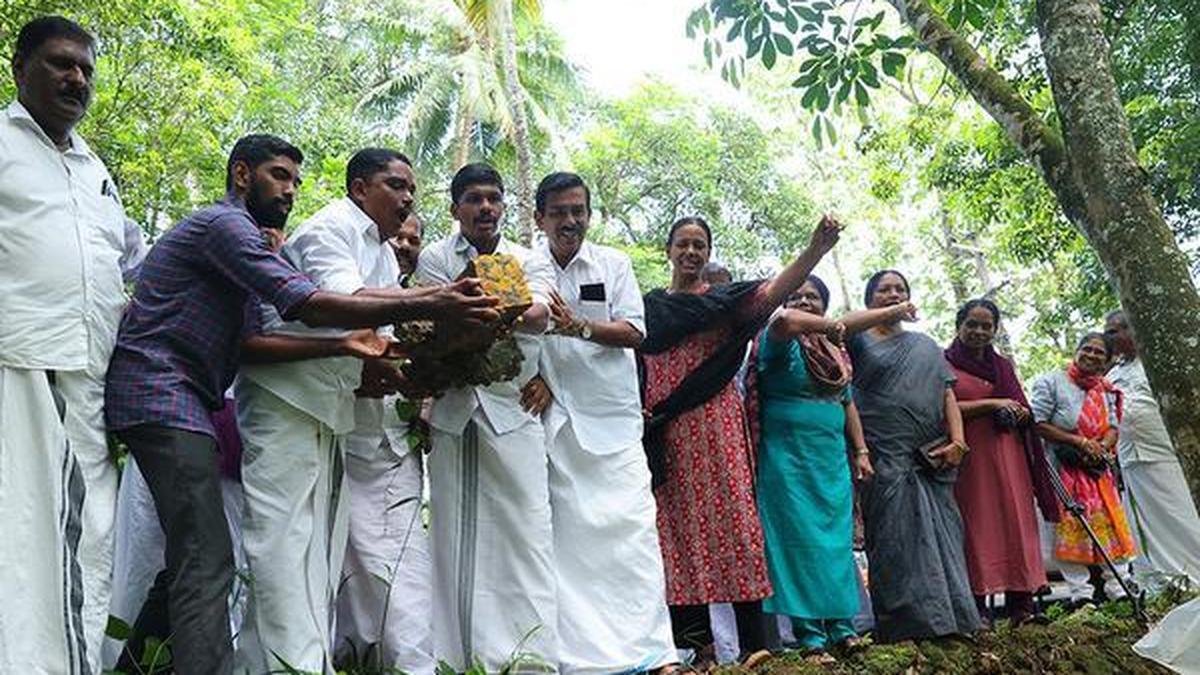
The project required the acquisition of around 1,221 hectares of land and was expected to affect more than 9,300 structures, potentially displacing nearly 20,000 people. Residents in several regions complained of officials arriving to place survey stones without prior notice. Allegations of heavy-handed enforcement during surveys in places such as Kozhuvalloor near Chengannur and Madappally near Changanassery fuelled tensions.
By October 2021, authorities had laid around 1,651 survey stones across 42.6 km in 14 villages under tight police protection. Protests, stone removals, police deployment, and legal action followed. The protests soon snowballed into a State-wide movement backed by Opposition parties, particularly the Congress.
What legal and administrative mechanisms were put in place to acquire land?
In August 2021, special tahsildar offices were set up across districts to oversee the process, followed by survey notices under the Kerala Survey and Boundaries Act, 1961 and acquisition proceedings under the Right to Fair Compensation and Transparency in Land Acquisition, Rehabilitation and Resettlement Act, 2013. But the process turned controversial. Land parcels marked for acquisition were effectively frozen, leaving thousands of residents unable to sell, mortgage, or develop their properties for months. The project’s social impact assessment and acquisition procedures were challenged in courts. Faced with mounting resistance, the government unveiled a ₹13,265 crore compensation package in 2022, which promised up to four times the market value of land along with housing assistance. Critics, however, argued that this would further strain Kerala’s finances. Despite these assurances, protests continued, and the government attempted to resume surveys using geospatial technology.
What were the concerns over the technical and financial viability of the project?
First, the Detailed Project Report (DPR) projected a daily ridership of 80,000 passengers and annual revenue of ₹1,605 crore based on a fare of ₹2.75 per km, which many considered optimistic. Second, technical concerns also mounted over the decision to adopt standard gauge instead of the conventional broad gauge network. Engineers flagged the alignment, pointing to hundreds of sharp horizontal and vertical curves that could limit sustained semi-high-speed operations. Third, while the DPR pegged the project cost at around ₹63,000 crore, a NITI Aayog assessment reportedly placed it closer to ₹1.25 lakh crore. Fourth, as the proposed corridor cuts through ecologically fragile wetlands, bird habitats, and flood-prone regions, experts warned that massive embankments could disrupt drainage patterns and worsen flooding during the monsoon. Finally, the Railways did not grant final approval to the project, citing incompatibility with existing infrastructure and concerns over future expansion of the national network.
What does the shelving of SilverLine mean for the future of K-Rail?
K-Rail is currently executing projects worth about ₹5,540 crore, including 66 railway overbridges, station modernisation at Thiruvananthapuram and Varkala, automatic signalling on the Ernakulam-Vallathol Nagar section, and implementation of the ‘Kavach’ train safety system. It also serves as consultant for KIIFB flyovers, Smart City projects, Kerala State Road Transport Corporation ticketing systems, and the Kochi Metro Phase II DPR, indicating that while the SilverLine project has been shelved, the institutional framework built around it remains active.