Land Monetisation in India: What the NMP Teaches Private Landowners
India is sitting on one of the most underutilised asset classes in the world: land. While the government has spent the last few years aggressively unlocking value from public infrastructure through structured asset monetisation in India, millions of private landowners are yet to realise that the same playbook applies to them. The National Monetisation Pipeline India has quietly changed how we think about assets and it holds a powerful lesson for every landowner in the country.
India's Shift Toward Asset Monetisation
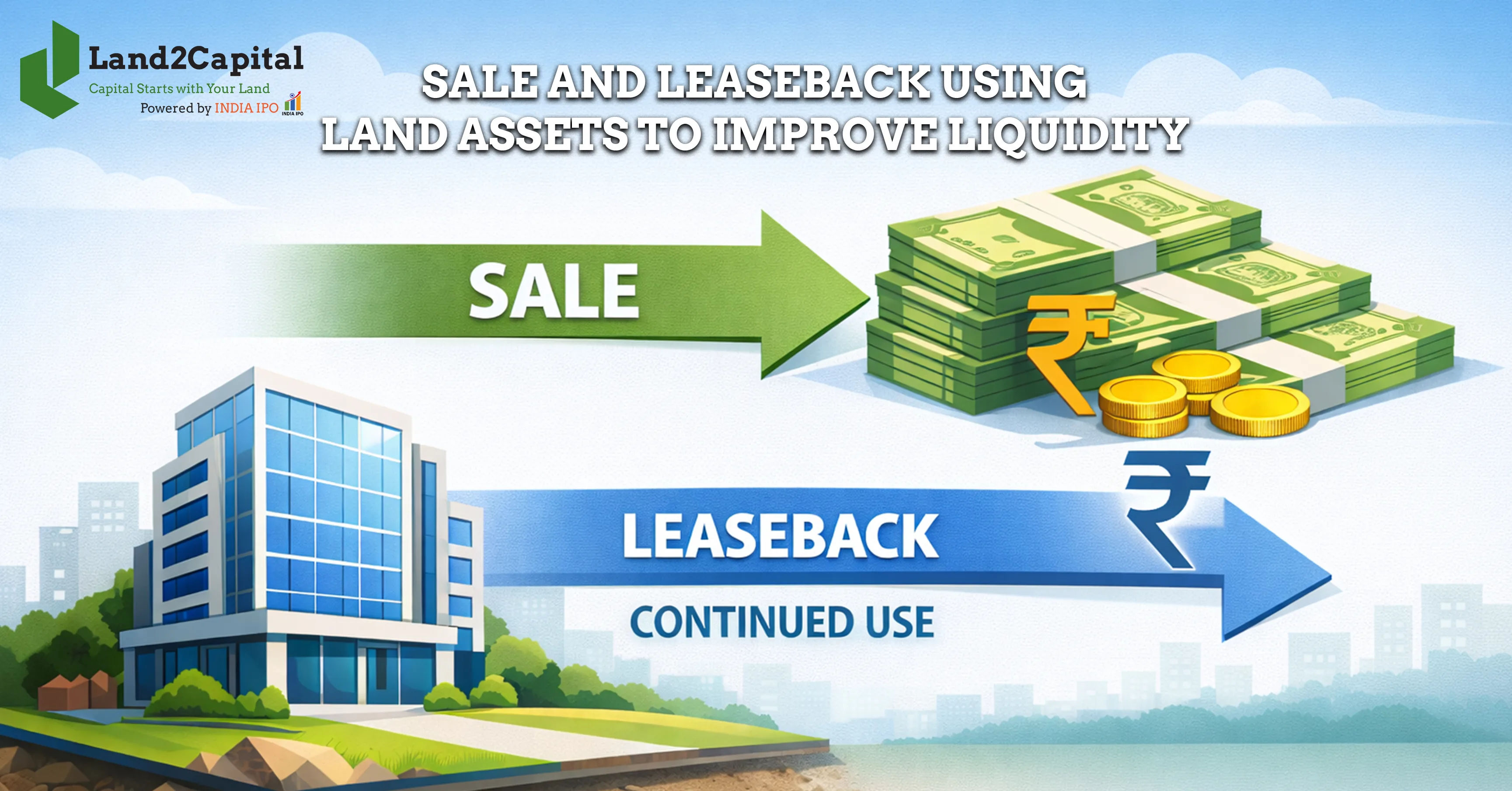
For decades, the conventional approach to unlocking value from an asset was straightforward: sell it. But India's infrastructure financing strategy has evolved dramatically. Asset monetisation in India is no longer about divestment; it's about generating long-term, recurring revenue from existing assets while retaining ownership.
The National Monetisation Pipeline in India, launched by NITI Aayog in 2021, embodies this philosophy at the national level. Rather than selling highways, airports, or power grids, the government is leasing them to private operators who bring capital, efficiency and management expertise. The government retains ownership; the private sector delivers returns.
This shift in land monetisation in India signals something larger: idle assets are a national liability. Productive assets are a national strength.
National Monetisation Pipeline India: A New Approach to Infrastructure Financing
The NMP represents one of the most ambitious infrastructure investment opportunities India has ever offered. Here's how it has evolved:
NMP 1.0: Monetising ₹6 Lakh Crore of Public Assets
Launched on August 23, 2021, by NITI Aayog in partnership with the Ministry of Finance, the National Monetisation Pipeline 1.0 was unveiled by Finance Minister Nirmala Sitharaman as a landmark infrastructure financing framework. The pipeline was designed as a four-year programme spanning FY2022 to FY2025, with a monetisation target of ₹6 lakh crore across brownfield public assets, that is, assets already built and operational, where private capital could step in to unlock efficiency and revenue.
The asset basket was broad and strategically chosen:
- Roads: 26,700 km of national highways under NHAI through Toll-Operate-Transfer (TOT) and InvIT models
- Railways: 400 railway stations, 90 passenger trains and 741 km of Konkan Railway infrastructure
- Power transmission: 28,608 circuit km of transmission lines under the Power Grid Corporation of India
- Gas pipelines: 8,154 km of pipelines under GAIL
- Airports: 25 airports under the Airports Authority of India (AAI)
- Telecom: 14,917 towers under BSNL and MTNL
- Ports: 31 projects across major ports
No asset was to be sold outright. The model relied on long-term leases, concession agreements, and operate-maintain-transfer (OMT) contracts; private operators would pay for the right to manage and earn revenue, while ownership remained with the government.
NMP 2.0: Expanding Asset Monetisation to ₹16.7 Lakh Crore
Building on NMP 1.0's structural foundation, NMP 2.0, launched on 24 February 2026, significantly raised India's ambition for asset monetisation. With a revised pipeline valued at ₹16.7 lakh crore, the scope was expanded well beyond core infrastructure to include gas pipelines, telecom towers, sports stadiums and infrastructure, warehousing under the Food Corporation of India (FCI) and urban assets such as public buildings and housing colonies under central government agencies.
NMP 2.0 reflected two important shifts: first, a recognition that NMP 1.0 had normalised the concept of monetisation without divestment across government departments; and second, a deliberate effort to bring diversified private investment into sectors beyond roads and railways. The inclusion of digital infrastructure, sports facilities and warehousing signalled that any revenue-generating public asset, regardless of sector, was a candidate for structured monetisation.
Critically, the ownership principle remained unchanged. Neither NMP 1.0 nor NMP 2.0 involves the sale of public assets. What is being transacted is the revenue-generating potential; the right to operate, develop and earn while the underlying asset stays within the public domain. This distinction is central to understanding why the NMP framework is both fiscally prudent and politically viable.
The Core Insight: Assets Should Generate Income
The most powerful takeaway from the NMP isn't a policy detail; it's a philosophy. Assets should not remain idle. Whether it's a national highway or a 10-acre plot on the outskirts of a Tier-2 city, the principle is the same: earn income from land in India rather than let it depreciate and miss an opportunity.
Passive income from land is not a new concept in theory, but it has historically been reserved for large developers or institutional players. The NMP demonstrates that, with the right structure and partners, any asset can be made productive.
If India's busiest airports can generate revenue without being sold, a private landowner's underutilised plot can do the same. This is the bridge between public policy and private opportunity that the NMP has inadvertently built and smart landowners are beginning to cross it.
India's Untapped Opportunity: Private Land Monetisation
India has an estimated 300 million acres of privately owned land, much of which is economically unproductive. But the country surrounding it is changing quickly, industrial corridors are broadening, urban frontiers are pushing outward and infrastructure buildout is churning at a rate unseen in decades.
Private land monetisation is emerging as one of the most compelling, yet underpenetrated, asset classes in India. Consider the macro forces at work:
- Urban expansion is pushing demand for mixed-use and residential development into previously rural or semi-urban zones
- Growth of Industrial corridors like the Delhi-Mumbai Industrial Corridor (DMIC) and Chennai-Bengaluru corridor is leading to acute demand for land around logistics as well as manufacturing hubs
- Land values in the close vicinity of infrastructure development, like roads, metro rail and smart cities, are increasing at a fast rate
- Renewable energy mandates will create a massive demand for land for solar and wind projects
Land investment opportunities in India have rarely been this broad or this deep. The challenge is not the absence of demand, it's the absence of structured access. Most landowners don't know how to connect their assets to capital, and developers are seeking exactly what they hold.
How to Monetise Land in India: Practical Models
Understanding how to monetise land in India requires moving beyond the binary of "sell or hold." There are multiple structured models, each suited to different land types, locations and owner risk appetites.
Land Leasing Opportunities in India
Leasing is the most straightforward path to passive income from land. Land leasing opportunities in India have expanded significantly across three high-growth sectors:
- Logistics parks and warehousing: The e-commerce boom and supply chain formalisation have created enormous demand for last-mile and mid-mile warehousing, particularly around Tier-1 and Tier-2 cities. Landowners near national highways or logistics corridors can lease land to 3PL operators and warehousing developers on long-term contracts.
- Renewable energy: Solar and wind energy developers require large tracts of flat, open land, particularly in states such as Rajasthan, Gujarat, Madhya Pradesh, and Karnataka. Long-term land lease agreements, often 25 to 30 years, provide predictable, inflation-linked income without the landowner bearing any development risk.
- Data centres and telecom infrastructure: As India builds out its digital infrastructure, land near urban centres with stable power access is increasingly sought after for data centre development.
Land Development Partnerships
For landowners seeking higher returns, land development partnerships offer an equity-like upside. Two common structures are:
- Joint Development Agreements (JDAs): The landowner contributes land; the developer contributes capital and construction expertise. Revenue or built units are shared in an agreed proportion. This model is widely used in residential and commercial real estate.
- Revenue Sharing Models: Common in infrastructure and commercial projects, in which the landowner receives a percentage of revenue generated by the developed asset over a defined period, rather than a fixed lease payment.
These structures allow landowners to participate in value creation without selling their land, mirroring the NMP's own logic.
Monetise Agricultural Land in India
Agricultural land monetisation is often overlooked but holds significant potential, particularly given India's push toward energy transition and food security. Practical options to monetise agricultural land in India include:
- Solar parks: Farmers and rural landowners can lease agricultural land to solar developers, earning annual lease income while retaining land ownership. Several state governments offer regulatory facilitation for agri-solar (agrivoltaic) projects that allow simultaneous farming and solar generation.
- Agro-processing zones: Industrial clusters focused on food processing create demand for adjacent agricultural land to support sourcing, storage, and processing infrastructure.
- Agri-warehousing: The Pradhan Mantri Kisan SAMPADA Yojana and similar schemes have catalysed demand for cold storage and grain warehousing in rural and semi-urban India, thereby creating direct land-leasing opportunities for agricultural landowners.
Rising Demand for Land: New Land Investment Opportunities in India
The demand side of India’s land market is being reshaped by structural, long-term forces rather than cyclical trends. Land investment opportunities in India are expanding across multiple high-growth sectors:
Industrial land opportunities amid the China-plus-one manufacturing shift in India, as global companies seek industrial land near ports, highways and SEZs. India’s Production Linked Incentive (PLI) schemes have accelerated this demand across electronics, pharma, textiles and auto components.
Commercial land investment India is benefiting from the rise of retail consumption, the expansion of Grade-A office space into Tier-2 cities and the rapid growth of co-working and flex-space operators.
Data centres are among the fastest-growing new demand categories. India is expected to require an additional 1,000+ MW of data centre capacity by 2027, driving demand for land near Chennai, Mumbai, Pune, Hyderabad and Noida with reliable power infrastructure.
Renewable energy remains the single largest driver of rural land demand. India’s 500 GW renewable energy target by 2030 translates directly into millions of acres of land required for solar and wind projects.
Infrastructure investment opportunities India in logistics driven by PM Gati Shakti, the National Logistics Policy and the growth of dedicated freight corridors, are creating land demand at an unprecedented scale along industrial and transport corridors.
Turning Land into Passive Income
The most compelling shift in the land monetisation narrative is the move from capital appreciation to recurring income. Historically, Indian landowners measured returns by the price appreciation over time. Today, structured monetisation enables landowners to earn income from land in India on an ongoing basis without selling.
Common revenue models include:
- Annual lease income: Fixed or inflation-linked rental payments from logistics operators, energy developers, or industrial tenants. Returns typically range from 4–8% annually on current land values, depending on location and use case.
- Revenue sharing: A percentage of revenues generated from the developed use, common in renewable energy projects and commercial developments. This provides upside participation beyond fixed rentals.
- Infrastructure partnerships: Long-term agreements with infrastructure operators or developers where the landowner receives periodic payments tied to project performance.
To take an example: a landowner with 20 acres along a national highway corridor in Haryana, leasing to a solar developer at ₹25,000 per acre per year, earns ₹5 lakh in passive annuity income from the land over the years, with zero development cost, zero capital deployment, and no operational risk.
The Role of a Land Investment Platform in India
The gap between land monetisation potential and actual monetisation is largely due to information and access problems. Most landowners don't know which sectors are actively seeking land in their region. Most investors and developers lack efficient access to fragmented private landholdings. This is precisely the gap a dedicated land investment platform India is designed to bridge.
Platforms like Land2Capital serve a critical intermediary role in the private land monetisation ecosystem by:
- Connecting landowners with verified investors and developers across logistics, renewables, industrial and commercial sectors
- Structuring land development partnerships, including JDAs, lease agreements and revenue-sharing arrangements with legal and financial rigour
- Providing market intelligence on demand drivers, lease rates and highest-and-best-use assessments across India's key growth corridors
- Unlocking land value for owners who have held underutilised assets for years, sometimes decades, without a clear path to monetisation
In essence, Land2Capital does for private landowners what the National Monetisation Pipeline has done for public infrastructure: it creates a structured, transparent and efficient system to turn idle assets into productive, income-generating assets.
Conclusion: The Future of Land Monetisation in India
The National Monetisation Pipeline has fundamentally changed how India thinks about assets. It has demonstrated, at a scale of ₹16.7 lakh crore, that ownership and income generation are two separate things. You don't have to sell an asset to make it work for you.
The same principle is now within reach for every private landowner in India. Land monetisation in India is no longer a concept reserved for large developers or institutional players. With the right model, partner and platform, knowing how to monetise land in India can turn a dormant asset into a consistent, long-term source of passive income.
As India's infrastructure, industrial and energy ambitions continue to grow, the demand for private land will only intensify. The landowners who act now, who structure their holdings intelligently rather than wait for a buyer, will be the ones who capture this generational opportunity.
Land2Capital is built to help you do exactly that.