Sale and Leaseback Using Land Assets to Improve Liquidity
For decades, land in India has been viewed as a passive asset or a reserve for future generations, providing long-term security but being non-liquid. However, in today’s increasingly capital-constrained environments, the perspective is shifting: land has become a core balance-sheet lever, essential for businesses adopting asset-light strategies to fuel growth, repay debt, or manage their capital structure. Companies are placing greater importance on these strategies, as seen in regional dominance: Delhi-NCR leads with 21% of total absorption in the core market, followed by Mumbai and Pune at 15% each.
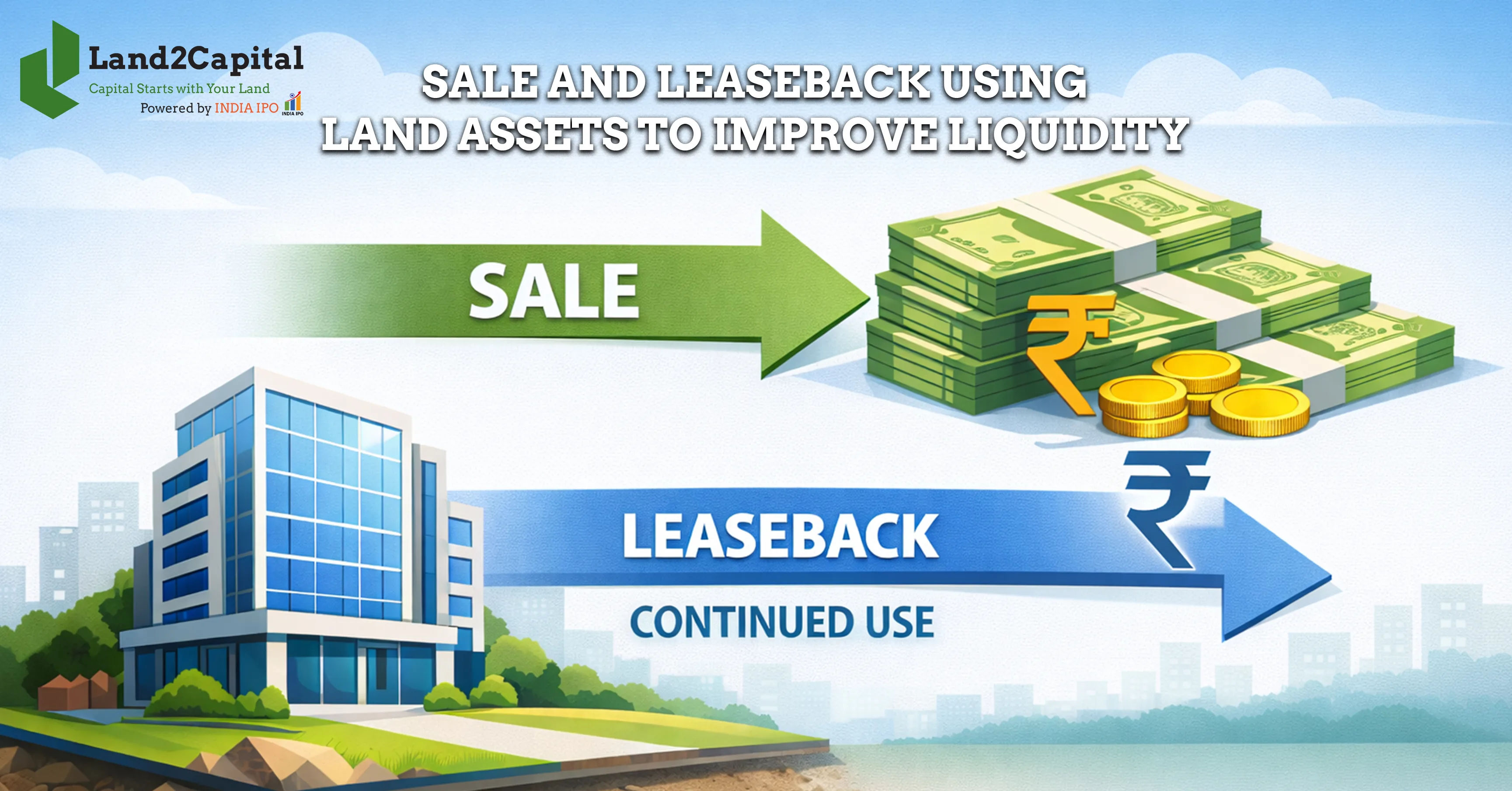
In simple terms, a sale and leaseback using land means you sell your land asset to an investor or buyer and then lease it back from them to continue your business in the same location without disrupting your operations or losing operational control, thereby improving liquidity from the land. This method of land monetisation through sale and leaseback allows you to unlock liquidity from land without losing operational control, ensuring your business stays rooted exactly where it needs to be.
This strategy is becoming an increasingly adopted strategy for asset-heavy sectors, as India’s Industrial & Logistics (I&L) sector hit a massive milestone in 2025 with 83.3 million sq. ft. of gross leasing, the highest ever recorded. It is particularly relevant for manufacturing companies, as it increases their market share from 16% to 27% in 2025, with sprawling footprints, logistics and roughly 40% of total warehouse absorption; retail chains with prime locations and infrastructure; or industrial businesses looking to recycle capital back into their core operations.
Understanding Sale and Leaseback: The Basics
What Is a Sale and Leaseback Transaction?
A sale and leaseback is a specialised financial strategy where an owner-occupier sells their land or real estate to an institutional investor and simultaneously leases it back on a long-term basis and the seller-lessee retains full operational control, ensuring no disruption to day-to-day operations despite losing legal ownership.
But it includes some types or variants that are important to understand, which are the following:
- Outright land sale: An outright land sale is a complete transaction where full ownership, title and property rights are permanently transferred to a buyer in exchange for payment.
- Mortgage or loan against land: A mortgage or loan against land is a financial agreement in which a property owner pledges their land as collateral to secure borrowed capital from a lender.
- Sale and leaseback structure: It can unlock close to full market value, subject to yield and lease terms, without increasing the company's debt-to-equity ratio. It effectively converts a "brick-and-mortar" asset into immediate working capital.
|
Feature |
Outright Land Sale |
Mortgage / Loan Against Land |
Sale and Leaseback |
|
Legal Ownership |
Transferred completely to the buyer. |
Stays with the owner (Borrower). |
Transferred to the investor. |
|
Right to Occupy |
Buyer takes possession. |
Owner stays in possession. |
Seller stays in possession (as a Tenant). |
|
Lump Sum Cash |
100% of market value. |
60%–80% of value (Loan-to-Value). |
Close to full market value, subject to yield and lease terms |
|
Recurring Cost |
None. |
Monthly principal + interest. |
Monthly rent payments. |
|
Risk of Loss |
None (Asset is already sold). |
Foreclosure if the loan is defaulted. |
Eviction if the lease is defaulted. |
|
Future Value |
Buyer benefits from appreciation. |
The owner benefits from appreciation. |
The investor benefits from appreciation. |
|
Tax Impact |
Capital gains tax on sale. |
Interest may be tax-deductible. |
Rent is often a deductible business expense. |
How the Structure Works Step-by-Step
The sale and leaseback structure is neither a comprehensive process nor a lightweight process, as it carries its own steps that need to be followed to make the financial clearings and process smooth. A sale and leaseback is a strategic financial arrangement that allows a company to maintain healthy liquidity and day-to-day operations while maintaining full operational control.
This step-by-step process enables businesses to convert illiquid real estate into immediate working capital.
- Sale of land to an investor or institution: The landowner sells its land title to a specialised investor or financial institution in exchange for a full market-value payout. This converts a fixed, illiquid physical asset into immediate liquid capital, which can be reinvested into more profitable business operations.
- Simultaneous lease agreement with the seller: At the point of the deal’s closure, the buyer and seller execute a legally binding lease contract. This ensures there is no gap in occupancy, making a transition immediately from a landlord to a tenant without interrupting daily business activities.
- Long-term usage rights held by the operating company: Even with the change in ownership, the operating company secures guaranteed access to the site through extended lease terms. This provides the business with the stability of a permanent location and the freedom to manage the premises according to its operational needs.
- Regular lease rentals rather than capital lock-in: By paying monthly rent rather than tying up millions in non-liquid assets, the company maintains a leaner balance sheet. This strategy replaces heavy debt obligations or stagnant capital with predictable operating expenses, significantly improving the firm’s overall financial performance and versatility.
Why Land Is Ideal for Sale and Leaseback
The land is usually seen as the ultimate form of collateral for these transactions because of its long economic life and stability. Unlike technology and other forms of equipment, for instance, land is less likely to become obsolete; in fact, it is a stable, long-life asset because it does not wear out or become technologically inferior. Also, India’s listed REIT (Real Estate Investment Trust) market cap surged more than 6-fold since 2020, reaching ₹1.73 lakh crore (approx. $20.5 billion) by early 2026.
The fact that land values increase or remain constant in the long run shows a high level of demand for property deals because of land’s ability to hedge against inflation. In addition, the use of land provides a smooth underwriting process for the investor and a simple model for long-term occupancy for the business.
Why Companies Are Monetising Land to Improve Liquidity
The Liquidity Challenge for Asset-Heavy Businesses
For many industrial and infrastructure-led firms, the balance sheet often tells a story of being "asset-rich but cash-poor." Often, non-productive assets, particularly land under factories or warehouses, hold significant portions of corporate wealth.
Not only private companies, but also the government use land to improve liquidity, as the Maharashtra government’s transfer of a large land bank of 83,904 acres to the Mumbai Metropolitan Region Development Authority
(taken from the Economic Times)
In the current economic climate, the cost of debt is rising and traditional bank financing is becoming more expensive, leaving many companies with limited access to unsecured debt. This is a liquidity choke point, where a company has millions in real estate assets but cannot fund its next level of innovation or its payroll cycle.
Strategic Drivers Behind Land Monetisation
Modern companies are increasingly leveraging land monetisation to transform stagnant real estate into dynamic capital, fueling rapid expansion and significantly strengthening their overall financial health.
- Unlocking land value creates quick liquidity to build new facilities or upgrade technology, eliminating high-interest debt and unfair lending rates.
- Sale and leaseback strategies substitute fixed assets with cash, can improve liquidity and optimise capital structure, though lease liabilities remain on the balance sheet for better market valuation.
- This strategy creates critical capital for high-growth areas such as R&D and marketing, changing the corporate model from real estate management to business innovation.
- Unlocking land value creates a critical cash reserve so that market seasonality or supply chain disruptions do not cripple day-to-day business.
Sale and Leaseback vs. Traditional Funding Routes
Currently, many companies still prefer traditional funding routes and perceive them as more familiar and secure. However, comparing borrowing costs with lease rentals requires context: while business loans may carry interest rates of 10.75% to 25% per annum, they typically finance only 60%–80% of the asset value, whereas lease rentals reflect a 6% to 10% yield on the full value of the land. As a result, the two are not directly comparable and have different implications for capital structure, cash flows and overall cost of capital.
However, in order to make the right capital decision, it is important to have a proper understanding of how different capital instruments affect the long-term viability of the organisation. Rather than raising capital in the form of equity, which involves a dilution of ownership, or taking on additional debt, which impacts credit, choose a sale and leaseback transaction as a "middle path."
|
Funding Option |
Impact on Ownership |
Balance Sheet Impact |
Cost |
|
Term Loan |
Retained |
Higher debt (Liabilities increase) |
Periodic Interest cost |
|
Equity Raise |
Dilution (Shareholders lose a % of control) |
Improves net worth |
High (Cost of equity) |
|
Sale & Leaseback |
Retained usage rights |
Asset-light (Cash increases) |
Fixed Lease cost |
The above table shows that whether a business takes a term loan, equity raise, or sale & leaseback, every path has its own pros and cons, but as a businessman, if we compare all three, choosing a acts as an alternative depending on capital strategy, as it doesn’t dilute equity in the company and doesn’t put much pressure on the company as a heavy debt.
By opting for a sale and leaseback, a company transitions to an asset-light model, maintaining the same operational footprint while gaining the financial versatility of a much leaner organisation.
How Sale and Leaseback Unlocks Capital from Land
Unlocking Liquidity Without Selling Permanently
The most significant advantage of a sale and leaseback is the ability to unlock liquidity from land without permanently selling it in an operational sense.
- Unlike traditional asset sales that require moving out, this modern approach ensures the company keeps full, uninterrupted control over the land.
- Since the lease is signed simultaneously with the sale, employees, machinery and production lines remain in place with no impact on continuity.
- These agreements are specifically designed for security, frequently offering long-term lease options that range from 20 to 40 years.
- Businesses maintain their established geographical presence for decades, combining the long-term certainty of ownership with the immediate liquidity of a tenant.
Quantum of Capital That Can Be Unlocked
When a company raises funds through the sale and leaseback method, it is often far superior to traditional debt. While a bank might lend 50% to 60% of a property's value, a sale and leaseback unlocks the Fair Market Valuation (FMV), which is frequently much higher than the historical book value recorded on the balance sheet. Several factors determine the final "quantum" of cash:
- Location and Zoning: Land in prime industrial corridors or areas zoned for high-value usage commands a premium.
- Usage Impact: Specialised improvements or strategic infrastructure can increase the asset's desirability.
- Lease Tenure and Yield: Investors weigh the lease term and yield expectations (annual rent relative to the purchase price) to determine the final valuation.
Typical Investors in Land Sale and Leaseback
In a sale and leaseback arrangement, the buyer is typically a "yield-seeking" investor. Unlike developers who buy land to build and sell, these investors want to hold the asset long-term to collect reliable rent.
That’s the reason not every buyer is a fit for a leaseback; the market is driven by various investors, some might be looking for stable, long-term yields rather than quick flips, or sometimes a quick flip is all that an investor wants. Some typical investors in sale and leaseback are important to know:
- Institutional Investors: This kind of group includes pension funds and insurance companies, whose land leaseback perspective is that of a "bond substitute"—a low-risk investment that provides steady, predictable cash flow over 15 to 30 years to match their long-term liabilities.
- Private Equity Real Estate (PERE) Funds: These funds pool capital from wealthy investors to acquire large-scale commercial land. They often look for "undervalued" corporate real estate where they can unlock value through creative lease structuring or future site intensification.
- REIT-like Structures: Real Estate Investment Trusts (REITs) are specialised companies that own and manage income-producing real estate. They use the leaseback method to grow their portfolios quickly, offering shareholders dividends derived directly from the monthly lease payments of the tenant.
- Family Offices: Managing the private wealth of ultra-high-net-worth families, these investors prioritise capital preservation and inflation protection. They are drawn to land because it is a tangible asset that can be passed down through generations while generating immediate passive income.
These investors provide a deep pool of capital, making it easier for large-scale enterprises to execute multi-million-dollar liquidity plays.
Financial Impact on the Company’s Balance Sheet
Immediate Balance Sheet Effects
Executing a sale and leaseback initiates a profound structural shift in a company’s financial health. The most visible immediate balance sheet effect is the conversion of fixed assets into liquid assets, essentially converting "trapped" value into a liquid resource.
This massive cash injection leads to a substantial reduction in net debt, as firms often use a portion of the proceeds to retire high-interest loans. Consequently, there is a marked improvement in liquidity ratios, such as the current ratio and quick ratio, signalling to investors and credit rating agencies that the firm possesses superior short-term solvency and financial flexibility.
P&L and Cash Flow Implications
From a profit and loss (P&L) perspective, the transition from owning to leasing changes the nature of corporate expenses. Instead of depreciation and interest, the company now records lease rentals as an operating expense. This can have a complex impact on EBITDA and margins, depending on the rental rate versus previous depreciation schedules.
However, the main point still comes back to the company's liquidity ratio and how well management is maintaining cash flow. Unlike variable interest rates or lumpy maintenance capex, a long-term lease provides a fixed, known cost for decades, allowing for more disciplined long-term financial planning and capital allocation.
Accounting & Regulatory Considerations
Modern treatment of sales and leaseback impact on companies under accounting standards (such as IFRS 16 or ASC 842) has changed. While the "off-balance-sheet" benefits of the past have evolved, the strategy remains a potent tool for capital recycling. Companies must navigate the distinction between off-balance-sheet vs. on-balance-sheet leases, where a "right-of-use" (ROU) asset is typically recognised.
Under the National Generic Document Registration System (NGDRS), land sale and leaseback agreements in states like Maharashtra and Karnataka are now registered digitally, reducing "deal-to-cash" time by nearly 40% compared to 2023.
Furthermore, the tax implications are significant; while the sale may trigger capital gains or stamp duty, the ongoing lease deductibility often provides a shield against taxable income, potentially lowering the effective cost of capital compared to traditional debt.
Land Monetisation Through Sale and Leaseback: Use Cases
Manufacturing & Industrial Companies
Manufacturing firms often sit on vast industrial tracts that have appreciated significantly since their initial acquisition. By monetising factory land, these types of companies can unlock massive internal reserves without moving a single piece of machinery.
Even the government has been working on the sales and leaseback method, as the economic corridors linked to the PM Gati Shakti initiative (like the Delhi-Mumbai Industrial Corridor) saw land values rise by up to 35% in certain clusters like Navi Mumbai in 2025.
This capital is frequently deployed toward funding capacity expansion, such as building new production lines or integrating automated robotics. Instead of being "land rich and cash poor," a manufacturer can use a sale and leaseback to transition into a more agile, high-growth entity while maintaining long-term tenure over its core facility.
Logistics, Warehousing & Industrial Parks
The logistics sector is perhaps the most natural fit for this strategy due to its reliance on high-value land with stable usage. Institutional investors are particularly drawn to logistics hubs because of their "mission-critical" nature. In warehousing and logistics, for grade-A industrial assets in 2026, the cap rates range between 8.5% and 10%.
The long-term lease attractiveness of a warehouse often spanning 15 to 25 years provides the investor with stable, bond-like yields, while the logistics operator gains the liquidity needed to scale their fleet or acquire smaller competitors.
Retail & Commercial Enterprises
The true potential for retail giants is found in their "back-end" infrastructure and to run a retail & commercial enterprise, a company needs to raise capital via modern funding routes. For SMEs, sales and leaseback is the best option, as banks give loans after complex formalities, but in this case, small retail enterprises can get the potential premium valuation, which will boost their liquidity and smooth their functioning.
By executing a sale and leaseback on regional distribution centres, retailers can recover the heavy capital expenditures associated with land acquisition and construction. Large Indian firms are shifting to an "asset-light" model by converting land into cash through sales and leaseback. The companies have improved their debt-to-NOI (Net Operating Income) ratios from 4.4x to approximately 3.9x in 2025-26.
Infrastructure & Utilities
Infrastructure and utilities companies, including those managing power plants, terminals and storage yards, possess land assets with immense intrinsic value. These assets are often tied to long concession-linked leases, making them incredibly secure for institutional buyers.
For a utility provider, a sale and leaseback offers a way to recycle capital from a completed project back into the "greenfield" phase of a new development, effectively creating a self-sustaining engine for infrastructure growth without relying solely on government grants or expensive public debt.
|
Asset Type |
2026 Yield (Expected) |
Primary Growth Driver |
|
Grade-A Warehousing |
8.5% – 10% |
Quick-commerce & 3PL expansion |
|
Prime Office (REIT-Ready) |
8.0% – 8.5% |
Global Capability Centers (GCCs) |
|
Tier-2 Commercial |
9.0% – 11% |
Strategic footprint expansion |
Key Structuring Elements in a Sale and Leaseback Deal
Lease Tenure & Escalation Clauses
The success of a sale and leaseback transaction depends heavily on how the lease is structured to balance investor returns with the seller's operational stability.
A lease tenure is typically a long-term arrangement (often ranging from 15 to 30 years) that provides the buyer with security and the seller with peace of mind. A critical component is the escalation clause, which determines how rent increases over time.
Companies must choose between fixed and variable escalation; while fixed increases (e.g., 2% annually) offer cost certainty, variable escalations tied to inflation indices (such as the CPI—Consumer Price Index) can protect the investor's real yield. The goal is alignment with business cash flows, ensuring that lease obligations do not outpace funds raised through a land leaseback.
Exit Options & Buyback Rights
The exit strategy in a sale and leaseback arrangement is defined by specific legal mechanisms that balance the investor's need for liquidity with the seller’s long-term operational security.
Call options allow the original seller to repurchase the land at a predetermined price after a certain period, providing a clear path back to ownership. In 2025-26, the companies have realised that paying an 8.5% rental yield is cheaper than the 10-12% cost of debt they would incur to buy back the land.
Complementing this is the Right of First Refusal (ROFR), which ensures that if the investor decides to sell to a third party, the tenant has the right to match the offer and reclaim the asset.
Risk Allocation Between Seller and Investor
The success of a sale and leaseback hinges on a precise Risk Allocation framework that defines the obligations of both parties. Most agreements utilise a "Triple-Net" structure, shifting maintenance responsibilities, insurance and taxes entirely to the seller (tenant) to ensure the investor receives a passive yield.
Conversely, regulatory and zoning risks are often shared, protecting the investor's asset value while ensuring the tenant's operational legality. Finally, robust force majeure and termination clauses provide a critical safety net, outlining exit protocols and financial settlements in the event of unforeseen disasters or structural breaches.
Risks and Challenges to Be Aware Of
Long-Term Lease Obligations
One of the most significant trade-offs is the transition from owner to tenant. By signing a long-term agreement, the company takes on fixed rental commitments that must be met regardless of business performance.
Unlike owning land, where you can reduce maintenance spending during a crisis, lease payments are non-negotiable liabilities. This creates a potential impact during downturns, where high fixed costs can strain margins if revenues dip. Companies should stress-test their ability to service the lease under various "worst-case" economic scenarios before committing.
Valuation and Deal Timing Risks
The "quantum" of capital you unlock depends entirely on the market at the moment of sale. There is an inherent risk of land undervaluation if the transaction occurs during a local market slump.
As sale and leasebacks are long-term deals, market cycle considerations are crucial; selling at the peak of a cycle is ideal, but rushing a deal during a liquidity crisis might mean leaving significant value on the table. Engaging independent, third-party valuers is essential to ensure the "Sale" price reflects the true fair market value, rather than a discounted "quick-sale" price.
Regulatory and Legal Risks
The legal foundation of the deal must be airtight; in the legal work, title clarity is the most common hurdle; any historical disputes or encumbrances on the land can stall or derail a transaction with an institutional investor. Additionally, land use approvals and zoning restrictions must be thoroughly vetted to ensure they align with the investor's requirements.
Finally, companies must account for local stamp duty and local laws, which can vary significantly by jurisdiction. Failure to structure the deal within these legal frameworks can lead to "failed sale" accounting treatments or unexpected tax burdens that erode the liquidity benefits.
|
Feature |
Standard Market Data (2025-26) |
|
Primary Term |
9 to 15 years (Retail); 5 to 9 years (Office). |
|
Lock-in Period |
Usually the first 3 to 5 years where the tenant cannot exit. |
|
Escalation |
12% to 15% every 3 years is the industry benchmark. |
|
Security Deposit |
3 to 6 months of rent (acts as a non-interest-bearing liability). |
When Does Sale and Leaseback Make the Most Sense?
While a sale and leaseback is a versatile financial tool, it is most effective when aligned with specific corporate milestones or structural needs. This strategy is particularly powerful for companies with surplus or under-utilised land, assets that are currently sitting idle on the balance sheet without contributing to daily production or revenue. By identifying these "lazy" assets, management can pivot from passive holding to active growth.
The decision to move forward typically makes the most sense for businesses seeking to raise funds using land assets to fuel a specific objective, such as a major technological upgrade or geographic expansion. From a financial performance perspective, this move is a proven way to improve Return on Capital Employed (ROCE). By removing a massive, low-yielding fixed asset (land) from the denominator of the ROCE equation and replacing it with high-turnover working capital, the company’s efficiency ratios often see an immediate and dramatic uplift.
Furthermore, this model is highly attractive for promoter-driven businesses looking to deleverage. It allows landowners to settle expensive bank debt using their own internal "land bank" rather than seeking outside equity that would dilute their control. Ultimately, firms preparing for IPOs or strategic investments often use sale and leaseback to "clean up" their balance sheets. Presenting a lean, asset-light structure with high liquidity and optimised debt levels makes the company far more attractive to institutional investors and public markets, often leading to a higher overall valuation.
Future Outlook: Sale and Leaseback as a Mainstream Financing Tool
With the economic shift in 2026, the global financial landscape has firmly embraced the sale and leaseback model as a sophisticated, mainstream alternative to traditional debt and equity. The historical obsession with "holding" land is giving way to a new era of capital efficiency, in which the value of an asset is measured by how effectively it can be put to work rather than by how long it sits on a balance sheet.
There is a growing institutional appetite for land-backed yield assets. In a market characterised by stabilising interest rates and a search for "inflation-proof" returns, pension funds, REITs and sovereign wealth funds are competing aggressively for long-dated, triple-net leases. These investors view land-backed leasebacks as "bond substitutes" low-risk, predictable income streams secured by tangible, mission-critical real estate.
We are seeing an increasing acceptance of asset-light balance sheets across the industrial and manufacturing spectrum. Boards of directors now recognise that owning the "dirt" under a factory often yields a lower return than investing that same capital into AI-driven automation, R&D, or market expansion. This mindset shift has positioned sale and leaseback as a vital tool for:
- Capital Recycling: Continually reinvesting real estate equity into higher-margin core business activities.
- Infrastructure Financing: Allowing utility and energy firms to fund the green transition by monetising existing brownfield sites.
- Industrial Growth: Enabling rapid scaling for logistics and warehousing players without the drag of massive upfront land costs.
Ultimately, the sale and leaseback has evolved into a strategic alternative to debt and equity. It avoids the dilution of an equity raise and the restrictive covenants of a bank loan, offering a 100% liquidity solution that keeps the business in control of its operational destiny.
Conclusion: Turning Idle Land into Growth Capital
The shift from a traditional ownership mindset to a strategic utility model is redefining corporate finance. As we have explored, a sale and leaseback is the most effective way for organisations to unlock liquidity from land without selling permanently, ensuring that mission-critical operations remain undisturbed while the balance sheet is revitalised. By converting a static, non-earning asset into immediate cash, businesses can transition from being "asset-heavy" to "growth-ready."
However, the transition requires more than just a willing buyer. Success in this market depends on a disciplined capital-allocation strategy in which proceeds are deployed into high-yield core operations rather than short-term fixes. It demands long-term planning to manage lease obligations and correct structuring to protect future buyback rights. Given the legal and tax complexities involved, the importance of professional advice cannot be overstated; expert guidance ensures that the valuation is fair and the risks are mitigated.
Ultimately, the takeaway for modern leadership is clear: Land is no longer just a mark of ownership, it is a powerful tool for financial leverage. When structured right, the very ground your business stands on can become the engine that drives its future expansion.