
Explore how Mumbai's infrastructure developments are transforming its luxury property markets, enhancing connectivity and driving up real estate values.
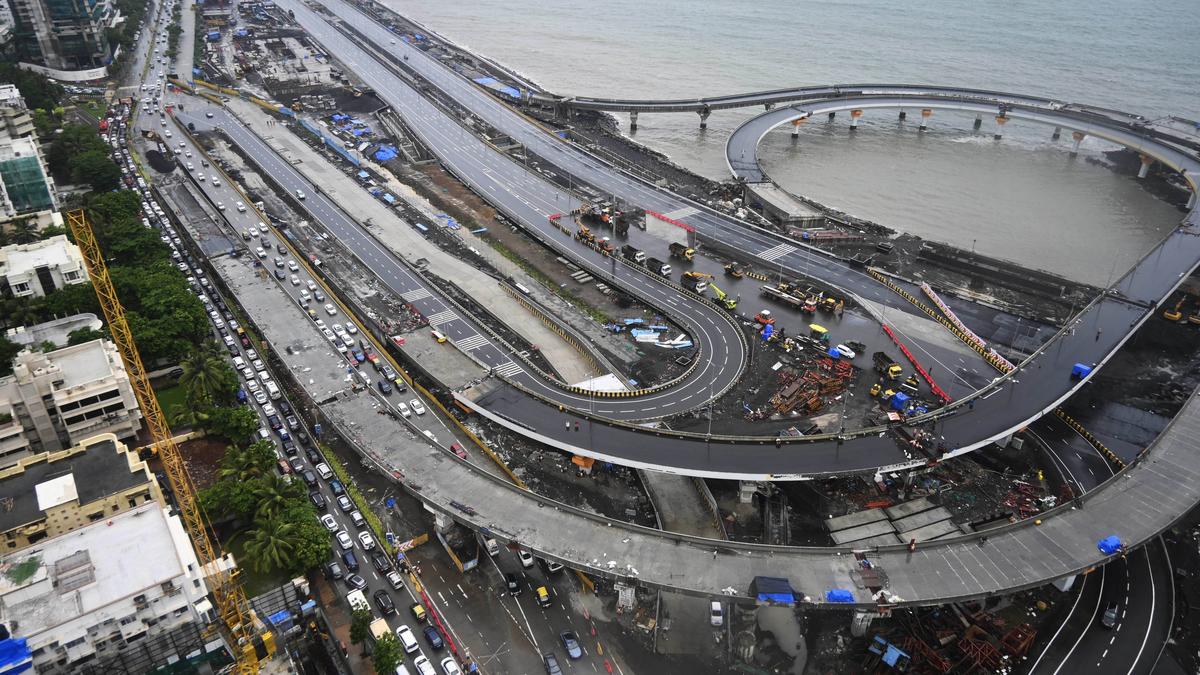
Over the last eight years in Mumbai, large-scale infrastructure developments, including the Coastal Road, the Mumbai Trans-Harbour Link, underground and elevated metros, and flyovers, have driven up real estate prices in the city. This has led to the creation of ultra-luxury real estate micro-markets, such as Worli, Versova, and perhaps the entire western seafront.
This is a significant development as even in the distant western suburb of Kandivali East, in North Mumbai, a penthouse recently cost ₹54,000 per sq.ft., which is very close to prices in Colaba in South Mumbai. This could be an isolated deal.
The partially operational Coastal Road is an eight-lane expressway that passes through the western coastline of the city, connecting Marine Lines [close to Nariman Point] in South Mumbai to Kandilavi in North Mumbai. Phase I, spanning 10.58 km, is now open between Worli and Marine Lines. This has certainly changed the dynamics. A transformative infrastructure project integrating high-speed, uninterrupted transport with access to the public has started doing wonders for Worli, once a nondescript industrial zone.
According to a December 2025 report by real estate consulting firm ANAROCK, Worli has emerged as India’s ultra-luxury capital, recording ₹5,500 crore in high-end home sales (30 units) over two years and capturing 40% of more than ₹40 crore apartment deals nationally.
Isha Ambani’s sprawling bungalow faces the Coastal Road, as does the Naman Xana tower, built by Shree Naman Group, which is under construction.
“The Coastal Road and Bandra-Worli Sea Link have driven Worli and Marine Drive prices up 20%-30% over the past two years. The premium units command ₹65,000 to ₹1 lakh per sq.ft., matching Lower Manhattan pricing,” says Anuj Puri, chairman, ANAROCK Group.
Two duplexes in Naman Xana were sold for ₹700 crore. Over 20 residential transactions in Worli were individually priced above ₹100 crore in the last three years alone.
In Worli, one could buy a less-than-1,000 sq.ft. flat for about ₹8 crore, while ultra-premium residences spread across 4,000 sq.ft. are priced above ₹32 crore.
Nearly million sq.ft. of premium residential and retail space is reportedly under construction, with an estimated ₹69,000 crore investment in completed or ongoing infrastructure projects now ribboning through the Worli micro-market. Prices have gone up sharply, according to ANAROCK.
Versova comes next
“Earlier, growth was largely driven by proximity, where people paid a premium to live closer to work because time was the biggest luxury. Today, infrastructure has begun to change that equation,” says Cyrus Mody, founder and CEO, Viceroy Properties.
Mody adds that Versova is a strong example of how infrastructure reshapes micro-markets. As the Coastal Road extends northwards and integrates with metro corridors and key arterial links, Versova’s connectivity to South Mumbai and major commercial districts is set to improve dramatically.
Landmark projects
“The landmark projects have fundamentally altered how the city functions, connects, and values space. Infrastructure today is not merely about enabling growth; it is actively recalibrating how the city is experienced and priced,” says Niranjan Hiranandani, chairman of Hiranandani Group & NAREDCO.
The Coastal Road has significantly reduced travel time between South Mumbai and the western suburbs, re-rating locations such as Worli and Prabhadevi into globally comparable luxury waterfront destinations. In addition to Versova, improved east-west and north-south connectivity through metro corridors has unlocked new value across areas like Andheri, and even micro-markets further north, adds Hiranandani.
“The Mumbai Metro expansion has generated 15%-25% property appreciation near stations, while the Trans Harbour Link is unlocking Navi Mumbai’s potential with expected 15%-20% price increases in Ulwe and Kharghar,” Puri says.
“ANAROCK’s Q4 2024 data confirms Mumbai’s dominance as India’s costliest market at ₹16,600 per sq.ft., significantly outpacing Bengaluru’s ₹8,380 per sq.ft.,” adds Puri.
“We have to be thankful to the State government for providing stability and transforming the city. It has had a massive benefit in terms of pricing and people considering living here,” says Tariq Ahmed, CEO (West India), Prestige Group.
Not to be left behind, the Bengaluru-based Prestige Group recently entered the Mumbai market and has started building marquee projects in Marine Drive and Worli with housing units priced between ₹30 crore and ₹45 crore and above.
Prakash Patel, chairman and managing director of Bhumi World, says connectivity enhancements across the Mumbai Metropolitan Region (MMR) have reduced commute times and opened up corridors that were once seen as inconvenient. “Naturally, this has boosted confidence among both homebuyers and businesses, contributing to a consistent uptick in property values. With MMRDA’s involvement, processes such as plan approvals have become more streamlined, and financial institutions are extending loans more easily. Lifestyle elements from dining to retail have also expanded, prompting more professionals to relocate closer to their workplaces,” he says.
Stating that projects are “collapsing travel times and redrawing mental maps of the city,” Vijay Choraria, managing director, Crest Ventures Ltd, a listed real estate company, says that as commuting friction reduces, luxury demand is moving away from legacy pincodes alone and going towards well-connected nodes that offer scale, openness, and long-term urban relevance.
Golf-course-facing developments
Mumbai is also witnessing the emergence of a second, equally compelling luxury narrative — iconic golf course-facing developments. This mirrors global benchmarks seen in cities like London, Dubai, and Singapore.
“In India, this format has, so far, been visible largely in Gurugram; Mumbai is now entering that league through locations such as Chembur and Mahalaxmi, where expansive, landscaped golf course views are being integrated into high-density urban living,” says Choraria.
According to analysts, what is increasingly visible is a buyer shift toward locations where infrastructure tangibly improves daily mobility and livability.
“Projects aligned with metro corridors and major road networks are demonstrating stronger pricing resilience, while legacy locations without direct connectivity upgrades are holding steady. Infrastructure today is influencing where buyers are willing to pay a premium, not pushing prices higher across the board,” says Ganesh Devadiga, principal partner and sales director of Square Yards, an integrated real estate platform in India. An analysis of active and recently launched residential projects across the MMR by Square Yards shows that infrastructure-led price effects remain uneven, corridor-specific and highly localised.
Below South Mumbai
Metro connectivity is driving relative price strength in the western suburbs, the firm says, adding that the region currently recorded an average residential price of ₹37,047 per sq.ft. This places the region above the central suburbs and harbour corridor; however, it is well below South Mumbai. “The zone does not lead Mumbai on headline pricing, yet it demonstrates one of the clearest infrastructure-led differentiations in value. Price strength is tightly concentrated in micro-markets aligned to Metro Lines 2A and 7, the Western Express Highway and key east–west connectors,” says Devadiga. These pockets consistently command higher buyer confidence and support larger ticket sizes, with an average unit minimum price of about ₹3.38 crore. Devadiga adds that in contrast, deeper western locations without direct metro access continue to transact at materially lower levels, pulling down the corridor-wide average.
The central suburbs remain one of Mumbai’s most price-accessible large residential zones, with an average rate of ₹29,266 per sq.ft. Despite substantial transport infrastructure and employment proximity, the zone’s pricing reflects its role as a volume-driven market rather than a premium one, as per a report by Square Yards.
Average ticket sizes in the central suburbs are the lowest among the four micromarkets, at approximately ₹1.96 crore, indicating continued end-user demand focused on affordability and functional housing. Infrastructure improvements in this corridor appear to be supporting absorption and market stability rather than translating into sharp price escalation. “The data suggests that while connectivity upgrades improve livability and commute efficiency, they have not yet been sufficient to materially compress the affordability advantage that defines the central suburbs,” says Devadiga.
South Mumbai continues to command the highest residential prices in the city, with an average rate of ₹55,817 per sq.ft. This premium is reinforced by the highest average ticket size across Mumbai, at roughly ₹6.71 crore, underscoring the capital-intensive nature of the market.
“However, South Mumbai’s pricing strength is not driven by recent infrastructure additions. Instead, it reflects structural factors such as extreme land scarcity, redevelopment-led supply and long-standing locational prestige. Price movement in this zone remains relatively stable, with limited volatility and low transaction volumes, characteristic of a mature market rather than one undergoing infrastructure-led repricing,” says Devadiga.
The western suburbs exhibit the strongest infrastructure-linked price differentiation, concentrated in metro-connected micro-markets rather than across the corridor.
Owing to strong demand in a supply-constrained market, real estate prices in Mumbai are expected to remain firm going forward.