
India's commercial real estate market is seeing record office leasing, rising demand for Grade A workspaces, and rapid growth in flexible office formats.
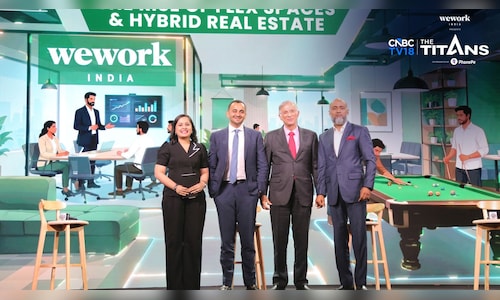
India's office market is undergoing a major transformation, driven by record leasing activity, growing demand for Grade A workspaces, and the rise of flexible office formats. Industry leaders at CNBC-TV18 The Titans discussed how hybrid work, infrastructure growth, and evolving business needs are reshaping the future of workplaces.
By CNBCTV18.com
India’s commercial real estate market is entering a defining phase. Even as several global markets continue debating the future of offices, India is witnessing record leasing activity, rising demand for Grade A workspaces, and rapid growth in flexible office formats. At CNBC-TV18 The Titans, presented by WeWork India and co-presented by PhonePe, industry leaders discussed how hybrid work, infrastructure expansion, and changing business expectations are reshaping the country’s workplace story.
The discussion featuring Karan Virwani, MD & CEO, WeWork India; Niranjan Hiranandani, Co-Founder & MD, Hiranandani Group and Gulam Zia, International Partner & Senior Executive Director, Knight Frank India, reflected a broader shift underway in commercial real estate. The future of workplaces, the panel suggested, is increasingly being defined by flexibility, accessibility, and experience.
A key theme emerging from the conversation was the growing acceptance of flexible workspaces as a mainstream office model. Karan Virwani noted that while flex spaces account for nearly 10% of India’s commercial office stock, they contribute close to 20% of all new leasing activity. According to him, the shift accelerated as businesses adopted hybrid work models and began prioritising agility and scalable infrastructure.
At the same time, the panel challenged the assumption that remote work would permanently weaken office demand. “People actually don’t want to work from home for extended periods. Businesses need teams to come together,” Virwani said, pointing to India’s faster return-to-office momentum compared to several global markets.
Niranjan Hiranandani expanded the conversation beyond offices to the evolution of integrated urban ecosystems. According to him, both residential and commercial real estate are increasingly being shaped by convenience, connectivity, and quality of life, with businesses and consumers seeking developments that combine workspaces, homes, retail, and infrastructure within the same ecosystem.
On the commercial side, he projected that 20–30% of all new Grade A office developments could move towards flexible formats over the next five years.
Offering a market-wide perspective, Gulam Zia noted that despite strong momentum, India’s office market remains underpenetrated compared to global commercial hubs. Rising demand from global capability centres (GCCs), domestic enterprises, and limited Grade A supply, he argued, continue to create strong long-term opportunities for the sector.
The discussion ultimately highlighted a larger structural shift: India’s workplace story is no longer just about office spaces. It is increasingly about building agile, experience-led ecosystems where work, infrastructure, lifestyle, and talent converge.
For more insights, visit https://ms.cnbctv18.com/titans/
Note To Readers
This is a partnered post.